Why Evaporative Cooling Is Ideal for Outdoor Adventures
From hiking in the Highlands to weekends at festivals, spending time outdoors is one of life’s greatest pleasures. But for people carrying temperature-sensitive medication, warm weather can add an extra layer of planning.
Whether you’re walking remote trails, camping under the stars or spending the day at the beach, access to refrigeration isn’t always possible. Fortunately, one of nature’s oldest cooling methods—evaporative cooling—offers a simple, reliable way to help keep medication cooler than the surrounding air, without electricity or ice.
Here’s why evaporative cooling is particularly well suited to outdoor adventures.
What Is Evaporative Cooling?
Evaporative cooling is a natural process that occurs when water evaporates.
As water changes from a liquid to a vapour, it requires energy. It draws this energy in the form of heat from its surroundings, reducing the temperature of the material it is evaporating from.
You’ve experienced this countless times:
- Sweat cooling your skin on a warm day.
- A damp towel feeling cool in the breeze.
- Traditional clay water pots keeping drinking water cooler in hot climates.
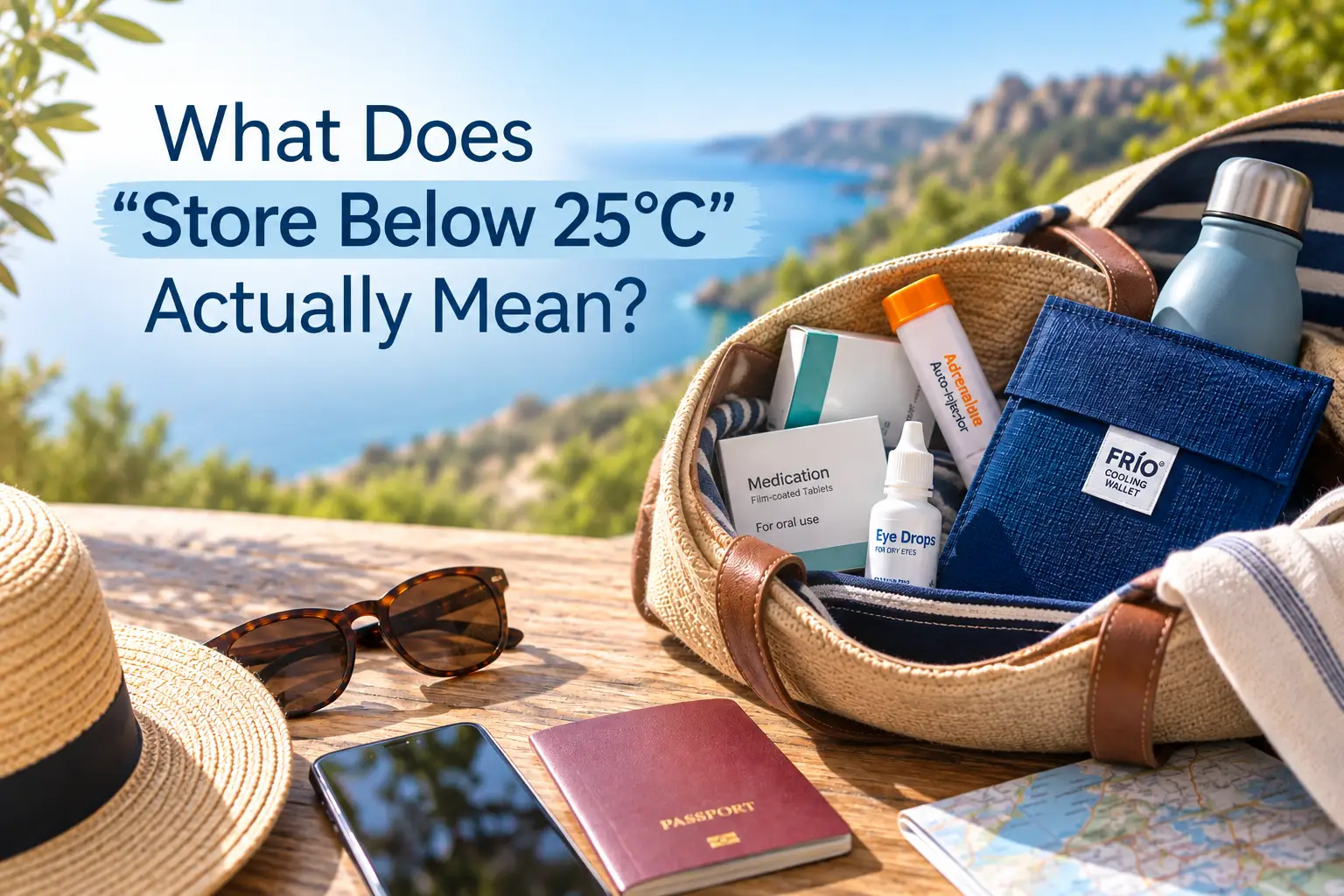
This same principle is used in evaporative cooling wallets such as FRIO.
The Science Behind the Cooling
The cooling effect comes from the latent heat of vaporisation—the amount of energy needed for water to evaporate.
At around 20°C, each gram of evaporating water absorbs approximately 2,450 joules (2.45 kJ) of heat energy. This continuous removal of heat helps maintain a temperature below the surrounding air, provided evaporation can continue.
Unlike refrigeration, evaporative cooling doesn’t create cold—it simply slows the warming of whatever is inside by continually removing heat.
Its effectiveness depends on:
- Air movement
- Relative humidity
- Ambient temperature
The drier the air, the greater the cooling effect. In humid conditions, evaporation still occurs but more slowly, reducing the cooling performance.
This is a well-established principle in thermodynamics and is widely used in engineering, agriculture and building design.
Why It’s Perfect for Outdoor Adventures
No Electricity Required
One of the biggest advantages of evaporative cooling is complete independence from power.
Whether you’re:
- hiking
- wild camping
- cycling
- fishing
- attending festivals
- travelling overseas
there’s no need for batteries, chargers or power banks.
Simply activate the cooling wallet with water according to the manufacturer’s instructions, and it continues working naturally.
No Ice Packs to Freeze Medication
Many insulated bags rely on frozen gel packs.
While these can keep contents cold, they can also create temperatures below 0°C if medication comes into direct contact with them.
This is important because insulin and many other biological medicines must never be frozen. Freezing can denature proteins and permanently reduce their effectiveness. The NHS advises that insulin which has been frozen should not be used.
Evaporative cooling avoids this risk because it works by gentle heat removal rather than freezing.
Lightweight and Easy to Carry
Outdoor adventures often involve carrying everything you need.
Evaporative cooling wallets are lightweight and reusable, making them practical for:
- backpacking
- mountain walking
- cycling
- kayaking
- beach holidays
- photography trips
- gardening
Without heavy ice packs, they add very little weight to your kit.
Continues Cooling While You Explore
One challenge during outdoor activities is maintaining consistent temperatures throughout the day.
A picnic, scenic viewpoint or afternoon on the beach may mean several hours away from refrigeration.
Because evaporative cooling works continuously while moisture remains in the cooling crystals or fabric, it can help provide ongoing protection during normal daytime activities.
Ideal for More Than Hiking
Evaporative cooling isn’t only useful for mountain adventures.
It can also be valuable during:
- Family days out
- Sporting events
- Music festivals
- Caravan holidays
- Camping trips
- Long-distance cycling
- Golf
- Sailing
- Fishing
- Gardening
- Wildlife photography
- Beach holidays
Any activity where refrigeration is unavailable for several hours may benefit from a passive cooling solution.
Making the Most of Evaporative Cooling
To maximise performance:
- Activate the wallet exactly as instructed.
- Allow excess surface water to evaporate before use.
- Keep the wallet exposed to air rather than sealed inside an airtight plastic bag.
- Store it in the shade whenever possible.
- Avoid placing it in direct sunlight for prolonged periods.
- Check your medication manufacturer’s storage recommendations before travelling.
Frequently Asked Questions
Does evaporative cooling work in humid weather?
Yes, but the cooling effect is reduced because water evaporates more slowly when humidity is high.
Does it need electricity?
No. The entire cooling process relies on natural evaporation.
Is evaporative cooling better than ice packs?
They serve different purposes. Ice packs provide stronger cooling but can accidentally freeze medication if used incorrectly. Evaporative cooling provides gentler temperature reduction without that freezing risk.
Can it be reused?
Yes. Evaporative cooling wallets are designed for repeated activation and reuse, making them suitable for regular travel and outdoor activities.
Enjoy the Outdoors with Confidence
Outdoor adventures shouldn’t be limited by concerns about keeping medication cool.
Evaporative cooling harnesses a simple scientific principle that has been used for centuries. By relying on nothing more than water and airflow, it offers a practical, reusable and electricity-free way to help protect temperature-sensitive medication while you’re exploring the world.
Whether you’re tackling a mountain trail, relaxing at a festival or enjoying a day by the coast, an evaporative cooling wallet can provide peace of mind—helping you focus on the adventure ahead.
Scientific References
- Cochrane Database of Systematic Reviews. Temperature and storage conditions for human insulin. 2024. https://www.cochrane.org/evidence/CD015385_temperature-and-storage-conditions-human-insulin
- NHS. Storing and travelling with insulin. https://www.nhs.uk/medicines/insulin/short-acting-insulin/storing-and-travelling-with-short-acting-insulin/
- Atkins, P., & de Paula, J. Atkins’ Physical Chemistry. Oxford University Press. (Latent heat of vaporisation and evaporative cooling principles.)
- ASHRAE Handbook – Fundamentals. (Psychrometrics and evaporative cooling principles.)